
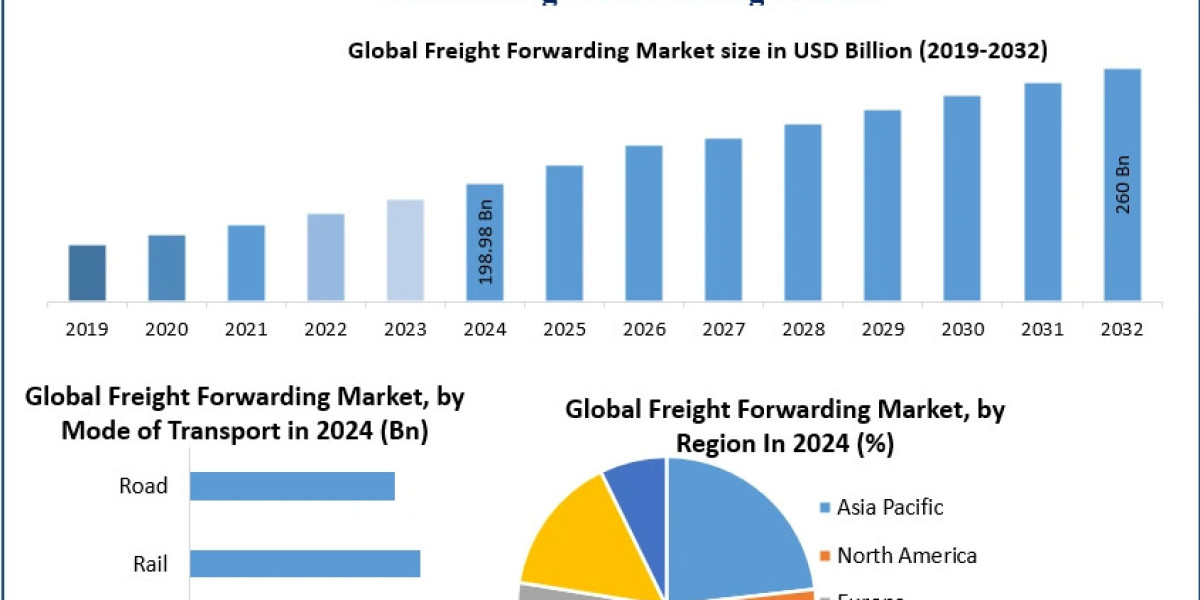

The Freight Forwarding Market size was valued at USD 198.98 Billion in 2024 and the total Freight Forwarding revenue is expected to grow at a CAGR of 3.4% from 2025 to 2032, reaching nearly USD 260 Billion.
Freight Forwarding Market Set for Significant Growth Driven by Global Trade and Technology
The global Freight Forwarding Market is on a steady upward trajectory, projected to reach approximately USD 260 billion by 2032, with a compound annual growth rate (CAGR) of 3.4%. This growth is fueled by increasing cross-border trade, booming e-commerce activity, and the adoption of digital solutions to enhance logistics efficiency.
Market Estimation & Definition
Freight forwarding refers to the strategic coordination and shipment of goods on behalf of shippers. These services encompass a wide range of logistics activities, including cargo booking, customs clearance, storage, and documentation, across air, sea, road, and rail transport modes. Freight forwarders play a pivotal role in international trade, ensuring cargo is delivered safely, efficiently, and in compliance with regulatory requirements.
Curious about the market dynamics? Get a free sample to explore the latest insights here:https://www.maximizemarketresearch.com/request-sample/148362/
Market Growth Drivers & Opportunities
Several key drivers are contributing to the expansion of the freight forwarding market:
Global Trade Expansion: The continued liberalization of trade policies and the growth of international commerce are increasing demand for freight services across sectors.
Technology Integration: Automation, data analytics, and digital freight platforms are streamlining operations, reducing errors, and providing real-time visibility across the supply chain.
E-commerce Boom: The surge in online shopping, particularly cross-border e-commerce, is driving higher demand for timely and flexible freight forwarding solutions.
Pharmaceutical and Perishable Goods Demand: Growth in the transportation of temperature-sensitive goods is creating opportunities for specialized freight services.
Strategic Logistics Hubs: Infrastructure development in emerging markets is enabling faster, cost-effective logistics services, boosting regional demand.
What Lies Ahead: Emerging Trends Shaping the Future
Looking ahead, several transformative trends are set to redefine the freight forwarding industry:
Green Logistics: Sustainability is becoming a core focus. Providers are investing in fuel-efficient fleets, alternative transport modes, and carbon offset programs to reduce environmental impact.
AI and Predictive Analytics: These technologies are enhancing demand forecasting, optimizing routes, and improving supply chain decision-making.
Blockchain for Transparency: Enhanced security and traceability through blockchain adoption are gaining traction, especially for high-value or sensitive cargo.
Omnichannel Logistics: Integration across multiple sales channels is leading to increased complexity and demand for agile, tech-enabled freight solutions.
Segmentation Analysis
Based on industry analysis, the freight forwarding market is segmented as follows:
By Mode of Transport: Ocean Freight Forwarding, Air Freight Forwarding, Road Freight Forwarding, Rail Freight Forwarding
By Application: Industrial & Manufacturing, Healthcare, Automobiles, Electronics, Military, Oil & Gas, Food & Beverages, Others
Ocean freight forwarding currently dominates the market, accounting for over 43% of total share, driven by cost advantages and high cargo capacity.
To Gain More Insights into the Market Analysis, Browse Summary of the Research Report:https://www.maximizemarketresearch.com/market-report/freight-forwarding-market/148362/
Country-Level Analysis: USA and Germany
USA: As one of the largest economies in the world, the United States plays a critical role in global freight movements. Strong demand from sectors like retail, manufacturing, and defense contributes significantly to the country's freight forwarding market. Technological innovation and a well-developed logistics infrastructure support continued growth.
Germany: Germany remains a key logistics hub in Europe, with its central location and robust transport network making it vital for intra-European and global freight flows. The market benefits from advanced automation and the presence of leading logistics providers.
Commutator Analysis
Although commutators are primarily linked to electrical motor systems, their relevance in freight forwarding is indirect but important. Automated warehousing and cargo handling equipment rely on electric motors, where high-quality commutators ensure efficient, durable, and low-maintenance operation. Enhanced motor performance supports faster and more reliable freight processing, ultimately improving service quality.
Conclusion
The freight forwarding industry stands at the crossroads of digital transformation and global trade growth. As supply chains become more complex and customer expectations rise, freight forwarders must adapt with smarter, more sustainable solutions. With strong growth prospects, especially in the USA and Germany, the market is set to evolve through innovation, automation, and integrated logistics strategies—solidifying its critical role in global commerce.