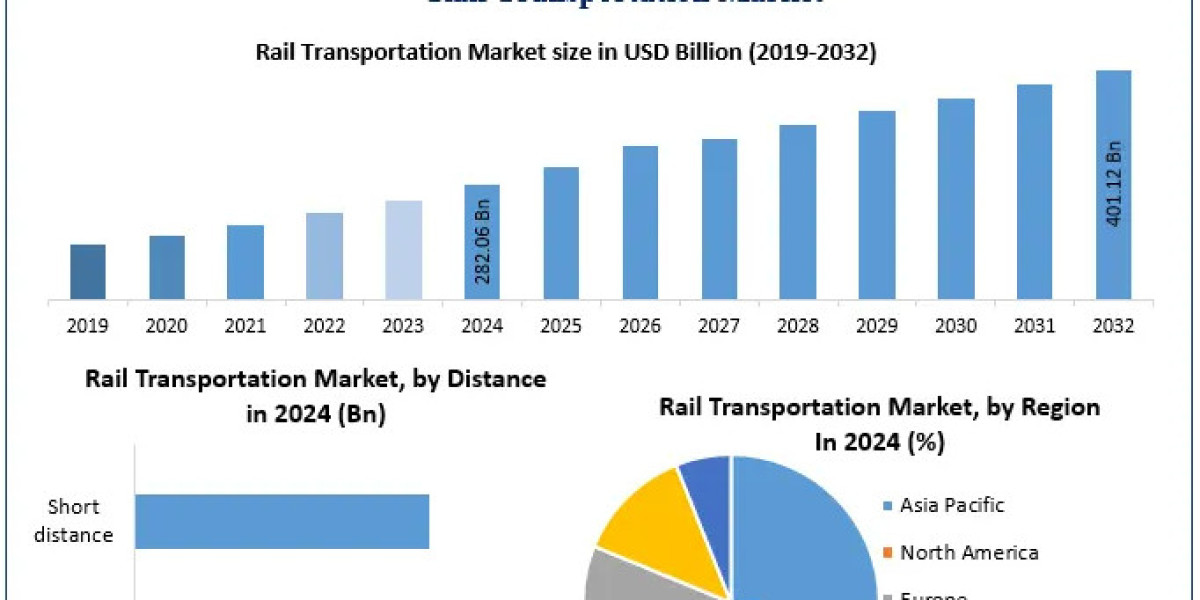

The Rail Transportation Market size was valued at USD 282.06 Billion in 2024 and the total Rail Transportation revenue is expected to grow at a CAGR of 4.5% from 2025 to 2032, reaching nearly USD 401.12 Billion.
Global Rail Transportation Market Set to Expand Steadily: A Deep Dive into Trends, Growth, and Future Opportunities
Market Estimation & Definition
The global rail transportation market is undergoing a period of steady expansion. In 2024, the market is estimated at approximately USD 282.06 billion and is projected to reach USD 401.12 billion by 2032, growing at a CAGR of 4.5%. Rail transportation refers to the movement of people and goods using rail systems, encompassing passenger trains, freight trains, high-speed trains, and urban metro systems. It is widely regarded as an efficient and environmentally responsible mode of land transport, particularly over long distances.
Curious about the market dynamics? Get a free sample to explore the latest insights here:https://www.maximizemarketresearch.com/request-sample/113747/
Market Growth Drivers & Opportunity
Several key factors are driving growth in this sector:
Government Infrastructure Initiatives: National governments are heavily investing in rail modernization and expansion, seeing it as a cornerstone of economic development and urban planning.
Environmental Benefits: Railways emit significantly less CO₂ compared to road and air travel, making them a central pillar of many countries’ sustainability goals.
Urbanization and Population Density: Rapid urban development has made mass transit systems a necessity in many regions, especially in high-density cities.
Freight Logistics: Rail is increasingly used for long-haul freight due to its cost efficiency and high capacity, especially in regions with developed logistics networks.
What Lies Ahead: Emerging Trends Shaping the Future
As the market evolves, several trends are expected to define its trajectory:
Digital Transformation: Technologies such as AI, IoT, and predictive maintenance are enhancing rail efficiency, safety, and scheduling accuracy.
High-Speed Rail (HSR) Projects: Numerous countries are expanding their HSR networks to reduce intercity travel times and stimulate economic connectivity.
Smart Rail Infrastructure: The emergence of intelligent signaling systems, autonomous trains, and smart ticketing solutions is changing the way passengers interact with rail systems.
Sustainability Commitments: Electrification of rail lines and the adoption of hydrogen-powered or battery-operated trains are becoming a focal point for green transitions.
Segmentation Analysis
The market is segmented by:
Type:
Passenger Rail Transport
Rail Freight
Distance:
Long Distance
Short Distance
Each of these segments is seeing unique innovations and growth depending on regional demands and investment priorities.
To Gain More Insights into the Market Analysis, Browse Summary of the Research Report:https://www.maximizemarketresearch.com/market-report/global-rail-transportation-market/113747/
Country-Level Analysis: USA and Germany
USA: Rail freight dominates the U.S. market, supported by an extensive private sector-operated freight network. The government is also pushing forward high-speed rail development and commuter line upgrades as part of its national infrastructure strategy.
Germany: A frontrunner in rail innovation, Germany is investing in digital railways, cross-border European connections, and carbon-neutral train technology. Its robust public transport system is a model of urban mobility efficiency.
Commutator Analysis
The market is marked by a mix of public and private players, each contributing to innovation and service expansion. Leading companies are prioritizing automation, fleet modernization, and public-private partnerships to stay competitive. The use of advanced propulsion systems and driverless technology is also reshaping the landscape of rail commuting.
Press Release Conclusion
The rail transportation industry is gaining strong momentum as nations prioritize infrastructure upgrades, urban mobility, and climate-conscious logistics. With digital transformation, high-speed connectivity, and green transport at the forefront, the sector is entering a dynamic era of growth and innovation. This makes rail transport not only a necessity of modern civilization but also a strategic component in building sustainable cities and resilient economies.