
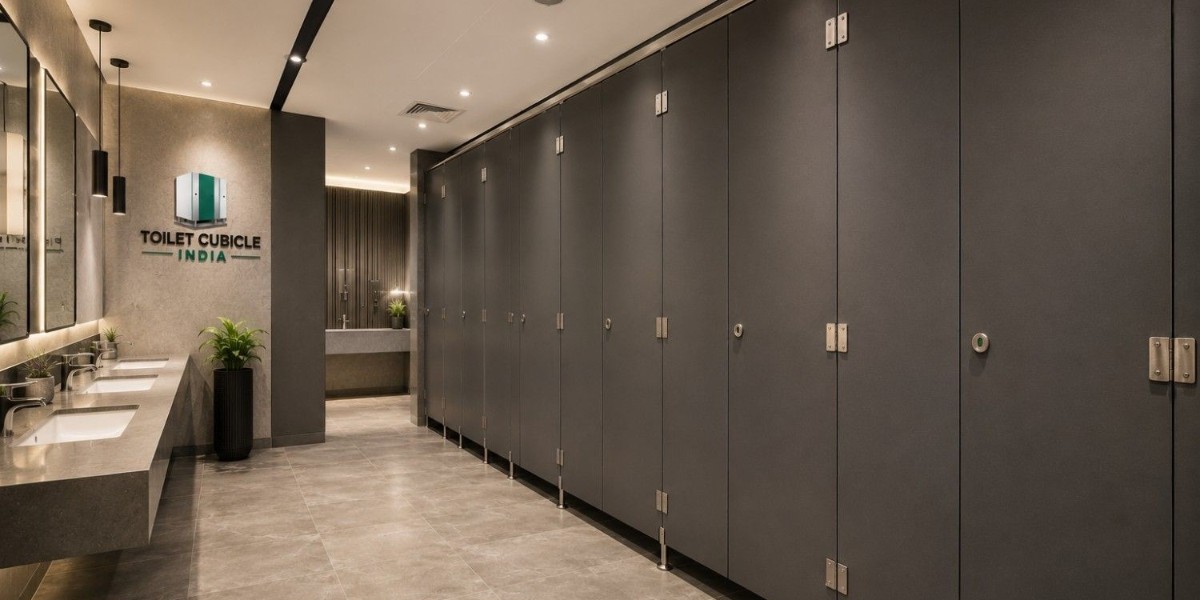

Find the right toilet partition manufacturers in India. Compare HPL materials, manufacturing quality, customisation, hardware and project costs.
Choosing the right toilet partition manufacturer is an important decision when planning a commercial or institutional washroom. The quality of the panels, accuracy of dimensions, hardware selection and installation process can all influence the finished system.
Commercial washrooms are used in offices, shopping malls, hospitals, schools, hotels, factories and public buildings. These environments require partition systems that provide privacy, make efficient use of space and suit regular cleaning and maintenance routines.
With different materials, designs and suppliers available, buyers should understand what to evaluate before placing an order. Comparing only the quoted price may not provide a complete picture of the product or service being offered.
Professional toilet partition manufacturers can help buyers understand available panel materials, dimensions, mounting configurations and hardware options according to their project requirements.
1. What Does a Toilet Partition Manufacturer Do?
A toilet partition manufacturer produces or fabricates modular panels and related components used to divide shared washrooms into individual spaces.
Depending on the business and project scope, a manufacturer may provide:
HPL compact laminate partition panels
Toilet cubicle doors and side panels
Pilasters and supporting components
Urinal privacy partitions
Hinges and indicator locks
Brackets and mounting accessories
Standard and customised configurations
Supply and, where offered, installation services
The exact scope varies between manufacturers. Some focus primarily on panel fabrication and supply, while others may also coordinate measurements, hardware selection and installation.
Before placing an order, clarify which services are included.
2. Materials Used by Toilet Partition Manufacturers
Material selection should be based on the washroom environment, expected usage, cleaning routine and project specification.
HPL Compact Laminate
High Pressure Laminate (HPL) compact boards are widely considered for commercial washroom partitions.
Depending on the grade and specification, HPL compact laminate can offer:
Good resistance to moisture
A durable surface for regular use
Easy-to-clean finishes
Different colours and decorative textures
Solid panel construction
Suitability for many commercial applications
These panels are commonly considered for offices, shopping malls, hotels, schools, hospitals and institutional buildings.
Buyers should confirm the panel grade, thickness and product specification before approving an order.
Stainless Steel
Stainless steel partition systems may be suitable for projects requiring a metal finish and a specification designed around frequent cleaning.
The steel grade, surface finish and hardware details should be checked to ensure that the selected system suits the intended environment.
Powder-Coated Metal
Powder-coated metal panels may be considered for certain commercial applications. Their suitability depends on the coating quality, edge protection, moisture exposure and maintenance requirements.
Other Engineered Panel Materials
Different manufacturers may offer additional panel options. Buyers should compare the construction, finish, maintenance needs and suitability for the intended washroom conditions.
3. Important Qualities to Check in a Manufacturer
Selecting a manufacturer requires evaluating more than the product catalogue. The following points can help buyers compare available options.
Material Specifications
Ask for details about the panel material, grade and thickness. A clear specification helps you understand exactly what is being offered.
Fabrication Accuracy
Panel dimensions and cut-outs should match the approved layout. Accurate fabrication helps with alignment and installation coordination.
Hardware Selection
Check the quality and compatibility of hinges, locks, brackets, handles and supporting fittings. These components are essential to the complete system.
Customisation Options
Different projects may require specific panel sizes, colours, finishes and mounting arrangements. Discuss customisation before approving the final design.
Clear Project Scope
The quotation should explain whether it covers panel supply, hardware, transportation, installation or additional site work.
Communication and Coordination
The manufacturer should be able to understand drawings, measurements and project requirements and communicate any practical limitations before fabrication.
4. Standard and Custom-Made Toilet Partition Systems
Not every washroom has the same layout. Some projects can use standard configurations, while others require customised dimensions and arrangements.
Standard Configurations
Standard systems may suit projects where the washroom layout matches commonly available panel dimensions and mounting arrangements.
They can simplify selection when the project has straightforward requirements.
Customised Configurations
Customised systems may be required when:
Washroom dimensions are non-standard.
Existing walls or columns affect the layout.
The project requires specific colours or finishes.
Door dimensions need adjustment.
Plumbing fixtures have fixed positions.
The building requires a particular partition arrangement.
The manufacturer should review the drawings and measurements before confirming the feasibility of a customised system.
5. How Manufacturing Quality Affects the Final Installation
A partition system is only as practical as its complete design and fabrication.
Several details deserve attention:
Panel dimensions: Panels should be manufactured according to the approved measurements.
Edge finishing: Panel edges should have a suitable finish for the selected material and application.
Door preparation: Hinge and lock positions should match the specified hardware.
Hardware compatibility: Fittings must be suitable for the panel thickness, door weight and mounting design.
Panel alignment: Fabrication and installation should allow the components to fit together according to the approved layout.
Finish consistency: Colour and surface appearance should be reviewed across the panels supplied for the project.
Requesting product samples or reviewing available finish options can help buyers make a more informed decision.
6. Factors That Affect Toilet Partition Manufacturing Cost
The cost of a toilet partition project depends on the material, design, quantity and installation requirements.
Important factors include:
Material type: HPL compact laminate, stainless steel and other materials have different cost structures.
Panel thickness: The specified thickness affects material consumption and system requirements.
Dimensions: Door sizes, panel heights and compartment layouts influence the quantity of material.
Hardware: Hinges, locks, brackets and supporting fittings contribute to the overall price.
Customisation: Special finishes and non-standard dimensions may affect fabrication requirements.
Order quantity: Project size and the number of washrooms influence procurement and production planning.
Transportation: Delivery location and site access may affect logistics.
Installation: Labour, fixing conditions and site readiness can influence the installation cost.
For a useful comparison, request an itemised quotation rather than relying on a single total price.
7. Questions to Ask Before Finalising a Manufacturer
Before approving the order, ask the manufacturer these practical questions:
Which panel materials and grades are available?
What panel thickness is being quoted?
Which hinges and locks are included?
Can the system be customised according to our drawings?
Are samples or finish options available?
Does the quotation include transportation?
Is installation included or quoted separately?
What site preparations are required?
What is the expected production and delivery schedule?
What maintenance guidance is provided?
Clear answers help avoid confusion between the product specification and the actual project scope.
8. Applications of Toilet Partition Systems
Toilet partition manufacturers serve a range of commercial and institutional requirements.
Offices: Partitions help create individual toilet spaces within employee and visitor washrooms.
Shopping Malls: They support organised washroom layouts designed for regular public use.
Hospitals: Material and layout selection should consider cleaning procedures and accessibility.
Schools and Colleges: Partition dimensions and configurations should suit the users and facility requirements.
Hotels: Finishes can be coordinated with the property's interior design.
Factories and Industrial Buildings: The system should be selected according to operating conditions and maintenance routines.
Airports and Public Buildings: Large facilities require careful coordination of compartment quantity, accessibility, circulation and maintenance.
9. Why Consider Toilet Cubicle India?
Toilet Cubicle India manufactures and supplies HPL toilet cubicles, washroom partitions, urinal partitions, shower cubicles and modular restroom solutions for commercial and institutional projects across India.
The product range is intended for different building types, including offices, malls, hospitals, educational institutions, hotels and industrial facilities.
Project requirements can be discussed according to the available washroom dimensions, preferred panel material, finish, quantity and installation scope.
If you are comparing toilet partition manufacturers in India, review the complete product specification and quotation before making a decision.
You can also explore HPL partition and modular washroom options from Toilet Cubicle India for your upcoming project.
10. Final Checklist Before Placing an Order
Use this checklist to review the manufacturer's proposal:
Confirm the panel material and grade.
Verify the panel thickness.
Approve colours and surface finishes.
Check door and partition dimensions.
Review hinges, locks and supporting hardware.
Confirm the mounting arrangement.
Match the fabrication details with approved drawings.
Check transportation and installation scope.
Confirm site readiness and delivery expectations.
Keep the final quotation and specifications documented.
A clear selection process helps buyers compare manufacturers on the basis of product suitability, specifications and project requirements.
Frequently Asked Questions
1. What should I look for in toilet partition manufacturers?
Check their available materials, panel specifications, fabrication options, hardware details, customisation capabilities, quotation scope and installation arrangements.
2. Which material is commonly used by toilet partition manufacturers?
HPL compact laminate is commonly considered for commercial washroom partitions. Stainless steel and other panel materials may also be available depending on the manufacturer.
3. Can toilet partition manufacturers provide customised dimensions?
Many manufacturers can discuss customised dimensions and configurations according to the project layout and technical feasibility.
4. What affects the cost of toilet partitions?
Material type, panel thickness, dimensions, hardware, quantity, finish, transportation and installation requirements all influence the project cost.
5. Do manufacturers provide installation services?
Service scope varies. Some manufacturers offer supply and installation, while others may provide panels and fittings only. Confirm this in the quotation.
6. Are HPL partitions suitable for shopping malls and offices?
HPL compact laminate can be considered for both applications when the correct grade, thickness and hardware are selected for the intended usage.
7. What details are needed to request a quotation?
Share the project location, washroom drawing or dimensions, required compartment quantity, preferred material, finish and installation requirements.