
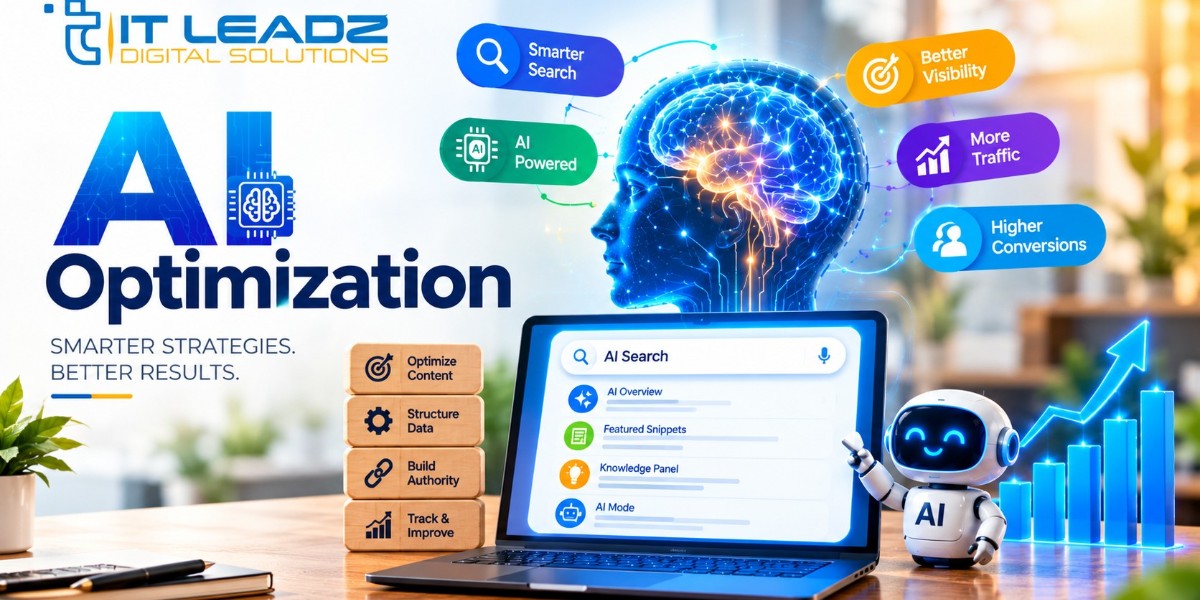

Learn how AI Optimization helps your brand appear in AI answers, summaries and chatbots. Explore strategies, tools and services to grow organic traffic.
Search has changed more in the last three years than in the previous fifteen. People still type queries into Google, but they also ask ChatGPT, Gemini, Perplexity, Copilot and voice assistants for answers. Those systems do not simply list ten blue links. They read, summarise, compare and recommend. If your business is not structured to be understood and cited by them, you can rank well in traditional results and still be invisible where decisions are increasingly made. This is the problem AI Optimization solves. In this guide, we explain what it is, why it matters, how it works and how to build a practical plan around it.
What Is AI Optimization?
AI Optimization is the practice of shaping your content, website and brand signals so that AI driven search systems can find, understand, trust and cite you. Traditional SEO focuses on helping a page rank in a list of results. AI Optimization focuses on helping your information become part of the answer itself. That difference changes how content is written and structured. A page optimised only for rankings might bury its best answer under a long introduction. A page optimised for AI systems leads with a clear, quotable answer, supports it with evidence and uses clean structure so a model can extract it with confidence. It also changes what success looks like. Alongside rankings and clicks, you track whether your brand is mentioned, cited and recommended inside AI generated responses.
Why AI Optimization Matters Right Now
Three shifts explain the urgency. First, AIgenerated summaries now sit at the top of many search result pages, which pushes traditional listings further down. Second, a growing number of users start their research in conversational tools rather than search engines. Third, AI systems favour a small set of sources for each answer, so being included or excluded has an outsized effect on visibility. For businesses, the practical consequence is that brand discovery is becoming more concentrated.
When an assistant answers “who are the best providers for this service,” it names a handful of companies, not a page of options. Those named companies capture attention and trust before a prospect ever visits a website. Businesses that invest early build an advantage that compounds. Models and search systems learn which sources are reliable, and consistent, wellstructured expertise tends to be reused.
How AI Systems Decide What to Cite
Understanding the selection process makes optimisation far less mysterious. AI search systems generally combine two things, knowledge learned during training and information retrieved from the live web at the time of the query. Your goal is to be present in both. For retrieval, systems favour pages that are crawlable, fast, well structured and clearly relevant to the question. For trust, they lean on signals such as author expertise, consistent facts across sources, reputable mentions and clear business information. For extraction, they prefer content that states things plainly, definitions, steps, comparisons, numbers and short direct answers. A page that is accurate, specific and easy to quote has a better chance of being used than a page that is long but vague.
The Four Pillars GEO, AEO, AIO and LLMO
Modern AI visibility work usually falls into four connected disciplines. They overlap, but each has a distinct focus.
Answer Engine Optimization targets direct answer experiences such as featured snippets, voice responses and chatbot answers. Our AEO( Answer Engine Optimization) and AIO services approach centres on questioned content, concise answers and schema markup that makes those answers machinereadable. Generative Engine Optimization focuses on appearing inside generated responses, where a model composes a new answer from several sources. It rewards original data, clear attribution and strong topical coverage.
AI Overviews optimization targets the summary panels shown at the top of search results. These favour well organised pages that answer the query completely and demonstrate expertise. Large language model optimization works on how models understand your brand at a deeper level, including consistent entity information, reputable citations and content that is easy to learn from.
Core Components of an AI Optimization Strategy
A strong programme is built from several parts working together. None of them is exotic, but together they form a system.
The first is content designed for extraction. That means question based headings, short answer paragraphs, definitions, lists, tables and evidence. The second is entity clarity making it unmistakable who you are, what you offer, where you operate and why you are credible. The third is technical accessibility, including crawlability, speed, clean markup and structured data. The fourth is authority, built through reputable mentions, reviews, partnerships and consistent citations across the web. The fifth is measurement, tracking mentions and citations in AI answers rather than relying only on rankings. Skipping any of these leaves a gap that weakens the others. Great content on a slow, poorly structured site underperforms. A technically perfect site with thin content has nothing worth citing.
Building Content That AI Systems Want to Use
Content is the centre of AI Optimization, and the standard is higher than it used to be. Generic summaries of what everyone else has said give a model no reason to prefer you. Content that adds something new does. Start each key section with the answer, then explain it. If a heading asks “How long does this take?”, the first sentence should say how long. Use plain language, avoid filler and define terms the first time you use them. Include original elements such as your own data, case outcomes, process details or expert commentary. Attribute facts to credible sources so that the claim is verifiable. Format matters as well. Lists suit steps and criteria. Tables suit comparisons. Short paragraphs suit definitions. When structure mirrors the question, extraction becomes easy.
The Role of Technical Foundations
AI systems can only cite what they can access and parse. That makes technical health a prerequisite rather than an optional extra. Sound Technical SEO ensures your pages are crawlable, indexable, fast and free of rendering problems that hide content from bots. Pay particular attention to a few areas. Keep important content in the HTML rather than hidden behind scripts that some crawlers cannot run. Maintain a clean XML sitemap and sensible internal structure.
Meet Core Web Vitals thresholds Largest Contentful Paint under 2.5 seconds, Interaction to Next Paint under 200 milliseconds and Cumulative Layout Shift under 0.1. Implement structured data using Schema.org types such as Organization, Article, FAQPage, Product and LocalBusiness so that entities and relationships are explicit.Review your robots rules too. Blocking AI crawlers by accident, or allowing them without a plan, both have consequences for visibility.
On Page Signals That Support AI Visibility
Pagelevel optimization still carries enormous weight, because every AI answer is ultimately built from individual pages. Strong On Page SEO makes each page easy to interpret a descriptive title, a single clear H1, logical subheadings, relevant internal links and precise language that matches how people ask questions. Add a short summary near the top of important pages. Use descriptive anchor text so that relationships between pages are clear. Keep metadata accurate, since titles and descriptions still influence how pages are selected and presented. Write image alt text that describes content rather than stuffing keywords.Consistency also helps. If your service page, your blog and your business profiles all describe your offer in compatible terms, models gain confidence in the facts.
Authority and OffSite Signals
AI systems do not rely on your website alone. They crosscheck what others say about you. Strong Off Page SEO builds the external evidence that makes your claims credible quality backlinks, editorial mentions, expert contributions, reviews and consistent profiles on respected platforms. Focus on relevance over volume. A mention in an authoritative publication within your field carries more weight than dozens of generic directory links. Encourage honest reviews, contribute original research or commentary, and make sure your brand name, description and contact details match everywhere they appear. Brand mentions without links also matter in this environment, because language models learn associations from text, not only from hyperlinks.
Key Facts and Figures to Keep in Mind
The table below summarises the most important reference points for planning an AI Optimization programme.
Area | Benchmark or Fact | Why It Matters |
Largest Contentful Paint | Under 2.5 seconds | Fast loading supports crawling and user experience |
Interaction to Next Paint | Under 200 milliseconds | Responsive pages are rated better on page experience |
Cumulative Layout Shift | Under 0.1 | Stable layouts reduce user friction |
Structured data standard | Schema.org vocabulary, ideally in JSONLD | Makes entities and answers machinereadable |
Ideal answer length | Roughly 40 to 60 words for a direct answer | Fits snippet and summary extraction |
Content refresh cycle | Review key pages at least every 6 to 12 months | Keeps facts current and trusted |
These figures are guidelines drawn from widely published search documentation and common practice, and they should be checked against current official guidance when you build your plan.
AI Optimization for Small Businesses
Smaller organisations sometimes assume this is only for large brands. In reality, AI systems often favour specific, expert and local sources, which gives smaller firms a genuine opening. AI Optimization for Small Businesses works best when it starts with the customers closest to you clear service descriptions, accurate business profiles, genuine reviews and content that answers the questions local buyers actually ask. You do not need a huge budget. Begin with your core service pages, rewrite them to answer questions directly, add schema, claim and complete your profiles and publish a handful of genuinely useful guides. Measure what happens and expand from there.
Applying AI Optimization to Online Stores
Productled businesses face particular challenges. AI shopping answers pull from product data, reviews, specifications and comparison content. Stores built on Shopify benefit from tailored Shopify SEO services that clean up collection structure, product schema and page speed so products are easy to interpret and recommend. Broader catalogue businesses also need a robust approach to Ecommerce SEO, covering category architecture, unique product descriptions, review markup, internal linking and buying guide content that helps models explain why a product suits a given need.Clear specifications, availability, pricing and return information should all be present in crawlable form, because incomplete product data is a common reason stores are skipped.
WordPress Websites and AI Visibility
A large share of business sites run on WordPress, and its flexibility is both a strength and a risk. Plugin bloat, theme scripts and inconsistent templates can slow pages and obscure structure. Dedicated WordPress SEO services help by cleaning up templates, configuring schema correctly, improving speed and ensuring that headings, internal links and metadata follow a consistent pattern. Good practice includes limiting unnecessary plugins, using a lightweight theme, enabling caching and image compression and making sure that each template outputs valid structured data. Small configuration fixes at the template level can improve hundreds of pages at once.
Specialised Optimization Approaches
Different AI environments reward different tactics. For generative answers, Generative AI Optimization emphasises original insight, authoritative citations and comprehensive topic coverage so that models can draw on your material when composing responses. For summary panels in search, AI Search Visibility Services concentrate on structuring pages so that they satisfy the full intent behind a query, including the follow up questions users are likely to ask next.For how models learn about your brand, AI Content Visibility Optimization strengthens entity consistency, factual accuracy and the presence of your expertise across the sources that models trust.
How to Measure AI Optimization Results
Measurement is where many programmes struggle, because AI answers are less transparent than ranking reports. The solution is to combine several indicators.Track branded and nonbranded search demand, since AI mentions often increase direct and branded queries. Test a fixed set of important questions across major assistants on a regular schedule and record whether you are mentioned, cited or recommended. Monitor referral traffic from AI platforms in your analytics. Watch conversions and lead quality, not just visits, because visitors who arrive after an AI recommendation often arrive better informed.Document your baseline before you start, so that improvement is visible and defensible.
Common Mistakes to Avoid
Several errors appear again and again. Publishing large volumes of generic, machinewritten content adds noise without authority. Ignoring technical access means good content never gets read. Inconsistent business information across the web weakens trust. Chasing every new tactic instead of building solid foundations wastes effort. Neglecting local presence leaves easy wins on the table for service businesses. The most damaging mistake is treating AI Optimization as a replacement for SEO. It builds on SEO. Strong fundamentals are what make advanced work effective.
Getting Started A Simple Roadmap
Begin with an audit of your top pages, your technical health and your current visibility in AI answers. Fix access and speed issues first. Rewrite priority pages to lead with direct answers and add structured data. Build a content calendar around the questions your customers ask. Strengthen your external presence through reviews, mentions and consistent profiles. Measure monthly, refine quarterly and refresh content regularly.For businesses that want expert support, a specialist team can compress this timeline considerably. You can explore the full range of support at itleadz.com, where services are organised around visibility across both classic and AI driven search.
Conclusion
Discovery is moving from lists of links to composed answers. Brands that make themselves easy to understand and worth citing will be part of those answers, while others fade from view. AI Optimization gives you a structured way to do that, clear content, solid technical foundations, credible external signals and honest measurement.Start with the basics, improve steadily and treat visibility in AI systems as an ongoing discipline rather than a one off project. The earlier you build, the stronger your position becomes.
Frequently Asked Questions(FAQs)
What is AI Optimization in simple terms?
It is the process of making your website and brand easy for AI systems to understand, trust and cite, so you appear in AI generated answers as well as traditional search results.
Is AI Optimization different from SEO?
Yes, though they are closely related. SEO aims to rank pages in result lists. AI Optimization aims to have your information used within generated answers. It builds on SEO fundamentals.
How long does it take to see results?
Technical and content fixes can influence visibility within weeks, but building authority and consistent citations usually takes three to six months of steady work.
Do small businesses need AI Optimization?
Yes, AI systems often favour specific, expert sources, so small businesses with clear and credible content can compete effectively.
Which pages should I optimize first?
Start with your main service or product pages, then your most visited guides and your business information pages.
Can I measure my visibility in AI answers?
Yes, Test a fixed list of questions regularly across major assistants, track referral traffic and monitor branded search growth.
Does structured data really help?
It helps AI and search systems interpret entities and answers accurately. It does not guarantee inclusion, but it removes ambiguity.
Should I hire a consultant or an agency?
If you lack in house technical and content resources, a specialist can speed up progress and avoid costly mistakes. Choose one that explains methods and reports transparently.